
- July 30, 2026
- Posted by: Hardy
- Categories: Dispute Resolution, Legal Insights
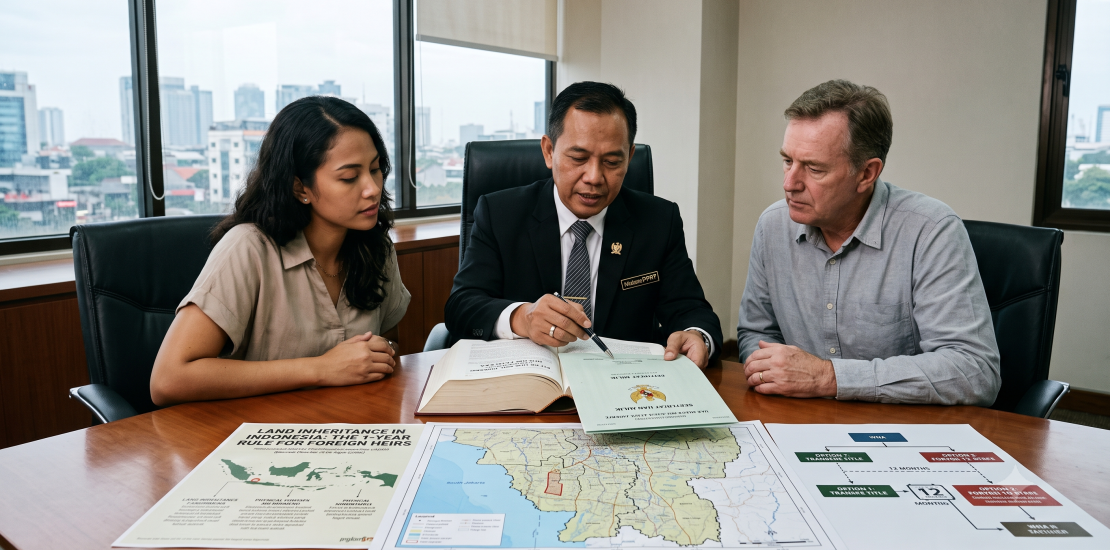
The execution of an estate can only take place after the decedent has passed away and the status of the estate has been determined. In principle, a biological child is only entitled to inherit the estate of his or her biological parents. If the estate is still commingled with joint property, the division of the joint property must be carried out first before the inheritance share can be determined and distributed, while taking into account the legal provisions of the decedent’s country of origin and the prohibition on foreign nationals owning freehold land.
The distribution of an estate under Indonesian law must follow clear steps to ensure legal certainty and justice, particularly for children born to the husband or wife. The basis for inheritance is set forth in Article 830 of the Civil Code (“KUHPerdata”), which states that inheritance occurs only upon death.
Furthermore, the legal relationship of inheritance is fundamentally predicated upon a blood relationship, as provided under Article 832 of the Indonesian Civil Code. Accordingly, an anak bawaan (a child from a previous marriage or relationship) maintains a civil law relationship solely with his or her biological parents. This legal relationship constitutes the principal basis for determining whether such a child is entitled to inherit and, if so, the extent of his or her inheritance rights in respect of the deceased’s estate. For the avoidance of doubt, in common legal and everyday usage, the term anak bawaan is generally understood to refer to a stepchild, namely a child brought into the current marriage by either spouse from a previous marriage or relationship, and who is therefore not a child born of the existing marriage between the spouses.
Furthermore, if an issue arises such as the death of a foreign national in Indonesia then pursuant to Article 16 of the Algemeene Bepalingen Van Wetgaving (“AB”), which essentially states that a person’s status and legal capacity follow that person wherever they go (the Nationality Principle), so if a foreign national dies in Indonesia, the applicable inheritance law is that of their country of origin.
There are several ways in which the assets of a foreign national who dies in Indonesia can be transferred, one of which is through a testamentary gift. Testamentary gifts are regulated under Article 957 of the Civil Code, which essentially states that a testamentary gift is “a specific provision whereby the decedent bequeaths to one or more persons certain items or all items of a specific type for example, all movable or immovable property, or the right to use or enjoy the proceeds from part or all of their property.”
In Indonesia, foreign nationals are permitted to make testamentary gifts as long as the subject matter of the will is located in Indonesia; however, there are specific exceptions regarding testamentary gifts of land. Article 21(3) of the Basic Agrarian Law explicitly prohibits foreign nationals from owning land under the “Hak Milik” title in Indonesia; therefore, if a foreign national owns land under the “Hak Milik” title in Indonesia, they are required to relinquish it within one year.
Essentially, Article 945 of the Civil Code governs Indonesian citizens (WNI) who are abroad. This article states that if an Indonesian citizen wishes to make a will abroad, they must do so officially and in accordance with the laws of the country where they are located. Legally, this rule can be applied conversely (interpreted) to foreign nationals. This means that foreign nationals currently in Indonesia also have the right to make a will.
In Judgment No. 280/Pdt.G/2021/PN Batam, Delvia Agustri (“Plaintiff”) is the biological daughter and sole heir of the late Erma Afnita, as determined by the Batam Religious Court’s Ruling No. 102/Pdt.P/2021/PA.Btm. The Plaintiff filed a lawsuit against notary/PPAT Wirlisman, S.H. (“Defendant”) to return 3 land certificates out of a total of 7 assets acquired during her mother’s marriage to Eddi Musgrove (a foreign national and the Plaintiff’s stepfather), on the grounds that the Defendant committed an unlawful act by refusing to return the documents.
The Defendant contested this, stating that the seven assets in question still constitute joint property and an estate between Erma Afnita and Eddi Musgrove that has never been divided by a court ruling. Since the Plaintiff is not an heir of Eddi Musgrove, the Plaintiff is not entitled to the share that rightfully belongs to his stepfather.
Pursuant to Judgment No. 280/Pdt.G/2021/PN Batam, the execution of the estate cannot proceed until the status of the property arising from the parents’ marriage has been determined by the Panel of Judges. Property acquired during the marriage constitutes joint property as provided for in Article 35(1) of Law No. 1 of 1974 on Marriage. Therefore, the division of joint property must be carried out first before the portion to be inherited by the Plaintiff can be determined.
Nevertheless, pursuant to Article 4 paragraph (1) of the Basic Agrarian Law (Undang-Undang Pokok Agraria or the “UUPA“), ownership rights over land may only be held by legal subjects that satisfy the qualifications prescribed under the prevailing laws and regulations. Furthermore, Article 21 paragraph (1) of the UUPA expressly provides that ownership rights over land may only be held by Indonesian citizens. In this regard, where a marriage exists between an Indonesian citizen and a foreign national, Article 21 paragraph (3) of the UUPA requires the foreign national who acquires ownership rights over land through inheritance or as a consequence of the mixed marriage to relinquish such rights in accordance with the applicable laws and regulations. Accordingly, with reference to District Court of Batam Decision No. 280/Pdt.G/2021/PN Batam, the Plaintiff, as the biological child of the late Erma Afnita from a previous relationship (anak bawaan), is afforded legal protection with respect to the ownership rights over the land forming part of his or her biological mother’s estate. Such protection arises because the Plaintiff’s entitlement is derived from the inheritance rights of an Indonesian citizen, whereas the Plaintiff’s foreign stepfather is prohibited under the UUPA from retaining ownership rights over such land.
In the present case, it may be concluded that an anak bawaan (a child from a previous marriage or relationship) is, as a matter of principle, entitled to inherit only from his or her biological parent, as the law of succession under the Indonesian Civil Code is predicated upon a blood relationship. However, the exercise of such inheritance rights cannot be effected where the assets forming part of the estate remain commingled with matrimonial property acquired during the marriage. In such circumstances, the identification, determination, and division of the matrimonial property must first be completed in order to ascertain the portion constituting the deceased’s estate, which may then be distributed to the lawful heirs in accordance with the applicable laws and regulations.
Farra Mutiara Nabila / M Faiz Ahyar
The information provided in this article does not, and is not intended to, constitute legal advice. Court decisions, legal interpretations, and factual circumstances differ in every case. Readers should contact a licensed attorney for counsel on any specific legal issue.